



Front doors
Internal security doors: when a door inside your home needs to be secure

In short
An internal security door is a reinforced door fitted inside your home to protect one room or one area. In England, building regulations set a security standard for doors into a new home, including a flat door off a shared hallway, but none for doors inside it. So you choose the level yourself, based on what the room protects. Check the wall, the fire-safety rules and the escape route before you choose.
An internal security door is a reinforced door fitted inside your home, not at the front, to protect one room or one part of the house. People choose internal security doors for a home office, a room that holds valuables, the door from an integral garage, or a flat door that opens onto a shared hallway. This guide explains what makes an internal door a security door, which UK standards apply, and how to decide whether you need one at all.
What is an internal security door?
An internal security door is a complete doorset (door, frame, lock and hinges) built to resist forced entry, and fitted between two spaces inside a building. It looks like a normal interior door. Inside, it is built more like a high security front door.
The usual parts are:
- A reinforced core. This is often steel, sometimes a steel sheet within a timber or composite leaf, so the door cannot be kicked or cut through easily.
- A reinforced frame. The frame is fixed into the wall at many points, so the door cannot be pushed out of its opening in one piece.
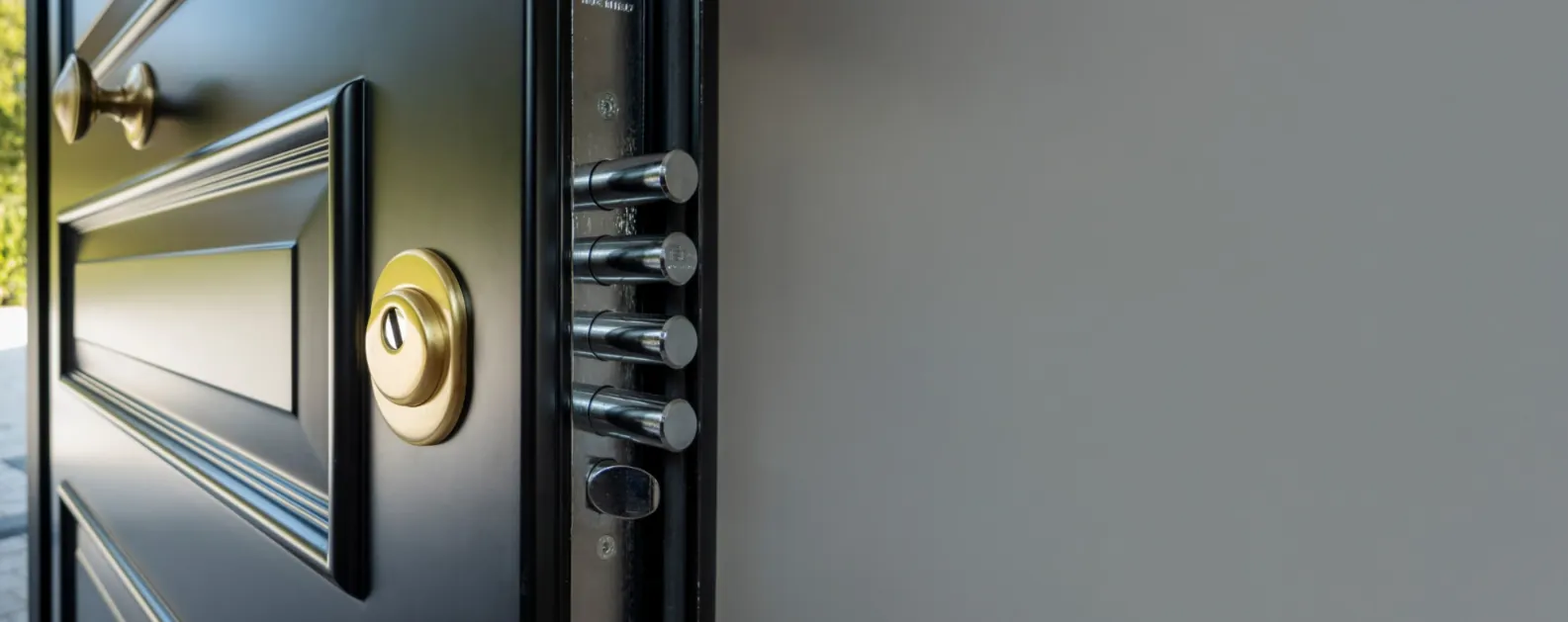
- A multipoint lock. Bolts shoot into the frame at several points, not one latch at waist height.
- Hinge-side protection. Hinge bolts or dog bolts hold the hinge edge closed even if someone attacks the hinges.
What makes it a security door is the whole set working together. A strong leaf in a weak frame is still a weak door. Our steel doors page explains how the same parts work on a front door.
Is a flat entrance door an internal door?
Start with this question, because the answer decides which rules apply.
If the door lets you into your home from a shared space, such as a communal corridor, landing or stairwell in a block of flats, it is an entrance door, even though it is inside the building. In England, Approved Document Q covers doors that give access into a dwelling. That includes a flat’s door from a common area. It applies to new dwellings in England. Wales and Scotland have their own building regulations.
If the door sits wholly inside your own home, between one room and another, Approved Document Q does not cover it. No building regulation sets a security level for it.
So the rule is simple:
- The door leads into your home from a shared space. Treat it as a front door. Look for a doorset tested to an enhanced security standard, and read our guide to burglar proof front doors.
- The door is inside your home. You choose the security level. Base it on what the room protects and who you are protecting it from.
The standards that apply to internal security doors
A door inside your home has no required security rating, but the same test standards used for front doors can guide your choice.
- LPS 1175 is a test standard published by the Loss Prevention Certification Board. It rates how long a doorset resists attack and with which tools. Certified products are listed on RedBookLive. Higher ratings mean the door resisted more tools for longer. Our guide to LPS 1175 and its SR ratings explains the grades in full.
- PAS 24 is a British Standards Institution specification for enhanced security doorsets for homes. Approved Document Q names it as one way to meet its requirement for entrance doors.
- Secured by Design is the police-backed scheme that recognises products tested to standards like these. Its rules are on the Secured by Design website.
A rating belongs to the tested product, at the tested sizes. When a supplier quotes a rating, ask for the certificate, and check that it names the doorset you are buying. Our certifications page explains how to read one.
Fire safety is a separate question. In England, Approved Document B sets fire-door requirements for some doors inside homes. Examples are the door between a house and an integral garage, and doors onto the stair in some taller houses and flats. A security rating does not mean a door is a fire door. If the door you want to upgrade is one of these, it may need to be both. Check with your Building Control body before you choose.
A room-by-room guide
Use this table to match the door to the job. It shows what to check first. It does not replace a survey.
| Where the door is | What it protects against | Security check | Fire-safety check |
|---|---|---|---|
| Flat door off a communal hallway | Entry from the shared parts of the building | Treat as a front door: Approved Document Q in England, enhanced security doorset | Usually needs to be a fire door, check with the building’s management and Building Control |
| Door from an integral garage into the house | Entry through the garage, which is often the less guarded way in | A security doorset with a multipoint lock and a reinforced frame | Approved Document B sets a fire requirement for this door, check the class needed |
| Home office with papers or equipment | Theft once someone is already inside, or access by visitors and trades | Choose a level that matches the value inside | Usually none, unless the door is on an escape route |
| Room that holds valuables | A determined attack with tools and time | A higher LPS 1175 rating, a strong wall and a careful fixing plan | Usually none, unless the door is on an escape route |
| Landing or stair door in a taller house | Closing off sleeping areas at night | Moderate security, easy to open from inside | May need to be a fire door, check Approved Document B |
Two points apply to every row.
Anyone inside must be able to get out without a key. A door that locks a person in can trap them in a fire. On any room someone might be inside, ask for a lock that opens from inside with a thumb-turn or handle.
Your insurer may have its own view. Some policies set conditions for locks and doors. Our guide to insurance approved doors explains what to ask before you buy.
A door is only as strong as the wall around it
The wall matters as much as the door. Front doors usually sit in solid outside walls. Internal doors often sit in stud partitions: timber or metal frames covered in plasterboard.
A high-rated doorset in a stud wall has two problems. First, the wall may not carry the weight of a steel door and frame. Second, someone who cannot get through the door may simply cut through the plasterboard beside it. The rating on the certificate describes the doorset. It does not describe your wall.
That is why a survey comes before the choice of door. A good survey of an internal opening looks at:
- What the wall is made of, and whether it can take the fixings the frame needs.
- The size of the opening, and whether it falls within the certified size range of the doorset.
- The floor, because a heavy door needs a level, solid threshold to close and lock properly.
- The route out, so the lock does not block an escape path.
- Any fire requirement, so a security door does not take the place of a fire door that the rules require.
Sometimes the right answer is a strong door with extra wall fixings. Sometimes the wall needs strengthening first. Sometimes the room does not need a high rating at all, and a well-fitted door with a good lock does the job.
Start with the opening, not the door
Whoever fits the door, the first step should be the same: look at the opening before anyone names a door, covering the wall, the opening, the escape route and any fire requirement.
We have spent forty years in the security trade, and the survey is where every job starts. If your flat door opens onto a shared hallway, or you are weighing up a security front door, book a free survey. We will tell you what the opening needs, and what it does not, and give you a written quote.
Frequently asked questions
- Do I need building regulations approval for an internal security door?
- Approved Document Q sets a security standard for new homes, and only for doors into the home, not for doors between rooms. A door on an escape route, or between the house and an integral garage, can still fall under the fire-safety rules in Approved Document B. Check with your Building Control body if you are unsure.
- Is a flat front door off a communal corridor an internal door?
- For building regulations it counts as an entrance door, because it lets you into your home from a shared space. In England it falls under Approved Document Q for new dwellings, so judge it as a front door, not as an internal one.
- Can an internal security door also be a fire door?
- Some doorsets carry both a security rating and a fire rating, but you cannot assume one rating covers the other. Ask for both certificates, and check that they apply to the exact doorset and size being fitted.
- Can I fit a steel security door in a stud wall?
- A stud wall may not carry the weight of a heavy doorset, and it may not resist an attack as well as the door does. A survey checks the wall first. Sometimes the frame needs extra fixing, or the wall needs strengthening.
- How much does an internal security door cost?
- There is no fixed price, because the cost depends on the size, the rating, the finish and the state of the wall around it. We give a written quote after a free survey.

